

A reel from @etymologynerd piqued my interest in Game Theory. In it, he described how social interactions played out, and how people tend to pick the safest ("dominant") position. This led into various interesting interaction, such as confessing your feelings:

In this example, he described why it is so hard for someone to tell their feelings. The usual strategy is to say nothing, as that will result in nobody's feeling hurt (overthinking doesn't count as hurt feelings). If one person confess their feelings, saying "I love you", the only good outcome is when the other person feels the same as well, saying "I love you" back. To have both to be happy, one needs to find out if the other party feels the same as well. This requires effort, and doesn't guarantee that the other person will feel the same, thus the "dominant" strategy is to say nothing.
You can see the full reels here: https://www.instagram.com/reel/DC9YYsnOa79/
Personally, I would argue otherwise. The chance that your feelings will be reciprocated is zero if you say nothing, but you will have a chance above zero if you confess (and work toward) your feelings. It's like saying you have never lost if you never participate in a competition, it's practically useless brag.
Will the dominant strategy always yield the best result?
That's the question I'm finding out. I'm reading this introductory book towards Game Theory, The Joy of Game Theory: An Introduction to Strategic Thinking by Presh Tawalkar. Don't worry, it is not a textbook read, but rather a practical looks on how game theory works in real life.
The author said that the dominant strategy might not always yield the best result. He gave an example of Prisoner's Dilemma. I will put an excerpt from the book:
The Two suspects are being questioned for a crime. While the police are pretty sure the suspects are guilty, they lack physical evidence and need at least one confession for a strong conviction.
The suspects are separated and interrogated in different rooms. The police do not use the usual tactics of bluffing to gain a confession. They instead tell each suspect that each will be rewarded or penalized based upon how each person acts. Here are the possible scenarios.
--If both suspects conceal information, then each will serve a 1 year sentence based on the minimal physical evidence.
--If both disclose information and confess, then both will be convicted and serve 3 years.
--If only one discloses information, then that suspect will be rewarded by being set free while the other partner will serve a heavier 4 year sentence as a penalty for not confessing.
Here's the table describing each situation:
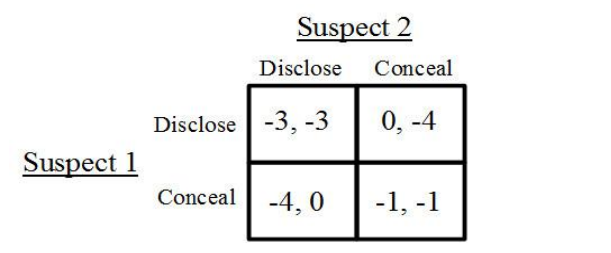
The best possible outcome for both suspects, is for both of them to conceal their crimes, and gain the most lenient sentence, one year each. However, if the other suspect chooses to disclose while the other is concealing the crime, the confessing suspect will be set free while the other are sentenced four years, the harshest sentence out of the possible outcomes. Thus, the dominant strategy is to confess, leading to both disclosing the crime and have both sentenced three years each, because you can't risk your partners to confess while you conceal the crime, and got yourself the harshest sentence.
This show how it is mutually destructive for both suspects, and breed mistrusts between each others. So, the dominant strategy might lead to worse solutions for both parties.
Is there a way out of the game?
Yes, you can be the one who profits from the game (the police in the prisoner's dilemma above), or change the rule. This is further described down in the book, so I encourage you to read it. Besides, I haven't finished the book, and I won't spoiler it all for you.
To quote a review from Goodreads,
Humans are not normally rational at Games and strategies.